
Airwaves Newsletter, Archives, News
Airwaves Quarterly Newsletter Edition 8
May

Airwaves: Edition 8 - Published 2026
Summer is here – the perfect time to put your home ventilation to the test. As we gear up for the festive season, find out what’s working and what could do with a little refinement. Do you have airflow in all the right places? Is your outdoor entertaining area cool and family-friendly?
Then check out issue 8, which includes…
- A sustainable off-grid retreat in iconic wine country
- Heat recovery ventilation (or, HRV) made easy
- Multi-award-winning collective housing with an edge
project showcase
Photography: Benedict Sutton
Patanga Estate: Off Grid and On Point
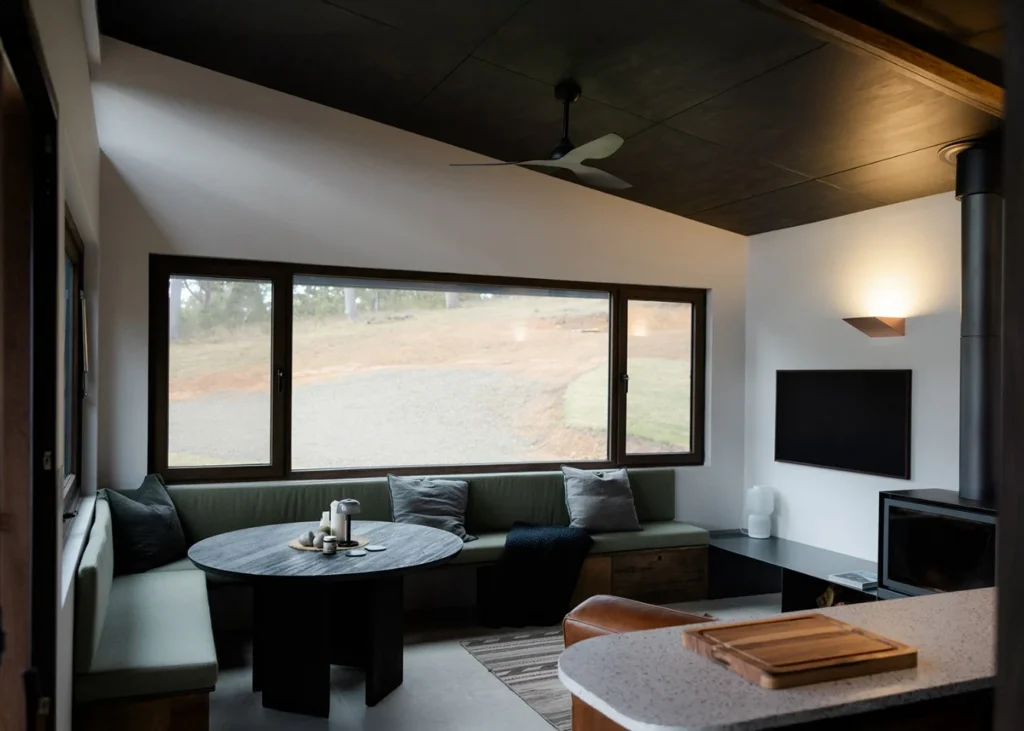
Nestled gently into the landscape, Patanga Estate is a sustainable rural retreat offering a blueprint for thoughtful, eco-friendly development in vulnerable natural areas.
On Wonnarua country in the beating heart of the Hunter Valley wine region, this stylish guesthouse honours its natural surroundings in sleepy Pokolbin in New South Wales. Set on a 25-acre, vine-ladened hillslope, Patanga Estate is a challenging collaboration by Fabric Architecture Studio and builders, Lou Projects.
From the outset, this unique green-field property had no established access, and no provision for water or electricity. Sustainable, off-grid thinking and clever strategies to minimise environmental impact were required to deliver this inspiring project.
The project
Patanga Estate takes sustainability seriously. It embraces energy self-sufficiency via solar generation and battery storage on site, and is dedicated to the preservation of natural habitat, biodiversity, and minimal environmental impact. No tree was removed during construction and grey-crowned babbler nests were carefully relocated.
The exterior blends sympathetically with its surroundings, as timber cladding, modest footings and a pitched roof present a subtle form. To the rear, understated decking reaches towards the hillslope to keep disruption to the natural surroundings to a minimum, both physical and aesthetic. Bushfire and ecological zoning requirements are also addressed, including the use of natural, bushfire-resistant materials.
Photography: Benedict Sutton
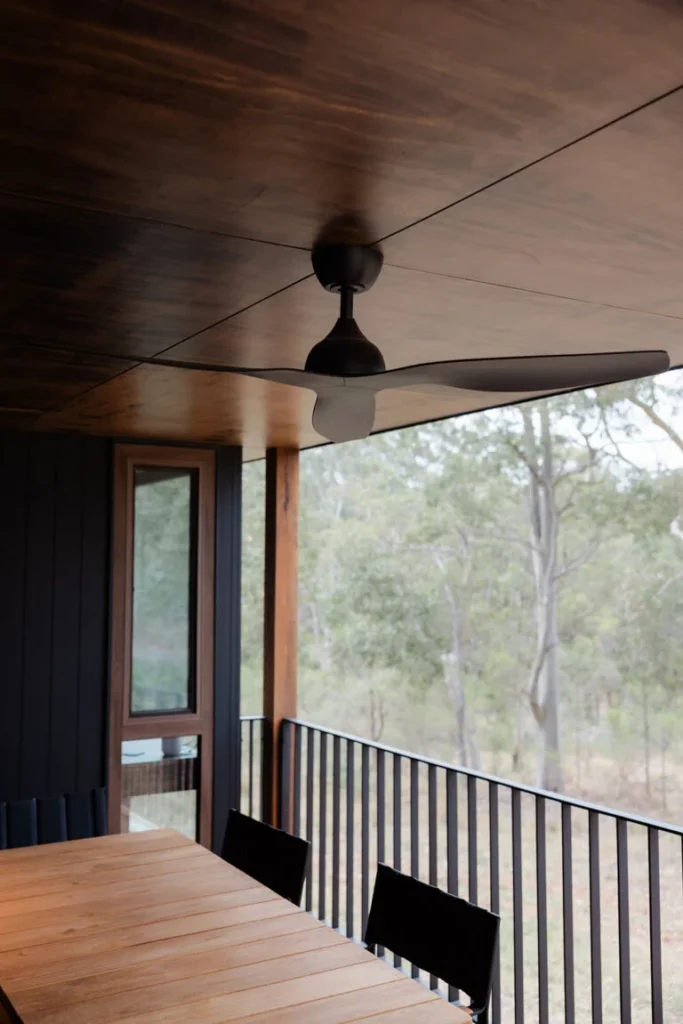
Inside, materials and finishes are selected for their sustainability and healthful characteristics, shaping sensitive interior spaces that are both good for the environment and healthy for occupants. Fanco Eco Style DC 52″ ceiling fans complement the refined design aesthetic and provide quiet ventilation, allowing guests to soak up the tranquil surroundings.
Project features
- Building blends with the landscape, with minimal environmental impact
- 21 kW solar array, 68 kW battery storage (with diesel generator backup)
- Healthy, sustainable materials – natural stone floors, low VOC finishes
- Custom joinery, sustainable and efficient Fanco Eco Style DC 52″ ceiling fans
- UPVC double-glazed windows for thermal performance
The last word
In a global environment where profits often trump principles, it is pleasing to see designers and leaders in the sustainability space continue to craft projects which uphold ideals rooted in thoughtful aesthetics, forward-thinking principles and gentle approaches to living with the land, rather than bending it to our will.
Looking for sustainable options for your next project?
Our expert ventilation team can help you compare a broad range of stylish, sustainable alternatives for your home or construction project.
an eye on the future

Courtesy Fanco website
An Exciting Future for Centralised Heat Recovery Ventilation
Centralised Heat Recovery Ventilation (or, HRV) is a relative newcomer to the ventilation space and it’s making powerful strides.
More Australian families are looking for energy-efficient approaches to constructing their homes and maintaining a comfortable sustainable lifestyle. HRV can be an important piece of the energy-efficiency puzzle in homes which are becoming increasingly air-tight and seeking greater climate control, year on year.
So, if you’re trying to keep up with the new technologies on offer, let’s start with a handy summary of what HRV is, what forms it can take, and how it can benefit your family and valued clients.
THE INS AND OUTS OF HEAT RECOVERY VENTILATION
Essentially, Heat Recovery Ventilation (or, HRV) is a cyclic ventilation system which brings freshly filtered air into the interior of your home, while sending stale stuffy ‘used air’ out. HRV’s filtration system removes external air pollution, pollen and other irritating particles, and reduces dust, mold and damp inside.
An important part of this process is HRV’s ability to capture the warmth and humidity of the departing air and to use it to heat and condition the fresh air entering your home. This clever, energy-efficient approach ensures a warm, comfortable home environment throughout the chilly months. It works in reverse on hot summer days using cool internal air to condition the warm incoming air.

Courtesy Fanco website
It’s HRV’s job to maintain a comfortable stable temperature within your home, using substantially less energy to provide consistent thermal comfort. The exchange of air also creates a healthier living environment by reducing your family’s exposure to air pollutants and unhealthy excess moisture in your home.
THE TECHIE BITS
Inside the HRV unit is a unique ceramic core which isolates warmth and humidity from the outgoing air then transfers it to the fresh filtered air coming in. Four distinct streams of air are maintained to ensure air quality – two in and two out.
Like a single split-system air conditioner versus ducted all-of-home heating, HRV can be both localised (single room) or centralised.
WHY CENTRALISED HEAT RECOVERY VENTILATION?
Centralised heat recovery ventilation is an all-of-home airflow system, which is typically up to 90% energy-efficient. A centralised HRV is a single large-scale HRV unit which connects with rooms throughout your home via ducting.
Typical centralised HRV unit specifications:
Airflow – 200-250m3 per hour at 100 pa
Heat recovery efficiency – 85 – 90%
Humidity control – not usually included
Filtration – G4 or F7
And then, there is Fanco’s Habitat Central.
Psst! This publication, airwaves, is all about innovation, legislation and design successes across our industry and the globe; never all about us. But this advance is too good not to share with you.
Now available, the Habitat Central pushes these impressive specs into a league of its own.
How the Habitat Central stands out:
Airflow – up to 300m3 per hour at 100 pa
Heat recovery efficiency – up to 92%
Humidity control – ceramic core creates enthalpy (managing interior humidity levels)
Filtration – G4 standard. Optional F8 or H13 upgrades
Note re filtration standards
G4 – removes particles such as dust and pollen
F8 – removes fine particles such as smoke and pollution
H13 – removes ultra-fine particles, approaching HEPA levels, such as some bacteria
HABITAT CENTRAL – LEAGUES AHEAD IN CUSTOMISATION AND CONTROL
Our product development team have scoured the world for the latest tech and customisation options for the Habitat Central to ensure you get the best unit you can buy with all the right features.
Choose your own level of control.
- With plenty of control options, from standard air quality management right up to fully customisable wifi operation, the Habitat is leaps and bounds ahead of typical HRV systems
Your home, your choice
Standard – 3.5’’ touchscreen wall control
Premium – 7” touchscreen wall control
Wi-fi module / app
Enthalpy included as standard.
- This means the unit not only filters and provides your living spaces with fresh air, it also uses inbuilt sensors to keep relative humidity consistent within your home. It helps ensure the air in your home is neither too moist, nor too dry.
Option to add external sensors to system.
- A unique feature is the option to fit external sensors for both CO2 and humidity to keep an extra eye on air quality and to put further customisation in place – greater peace of mind and a healthy addition in highly congested or polluted areas.
With the latest in global tech, we’re not just ready for here and now, we’re geared up for the future.
ARE YOU READY FOR CENTRALISED HRV TECHNOLOGY?
If you’d like to learn more about the powerful benefits of Centralised Heat Recovery Ventilation and how it can be designed to enhance your next project, arrange a chat with one of our friendly ventilation consultants. Contact us.
a world of design

Photography: Image courtesy the architect
Sharing the airwaves love around, each edition, we shine the spotlight on a design project deserving your attention. Projects making big moves. Gaining respect globally. Leading the way in innovation and sustainability.
This month, our team’s pick is Modulus Matrix (Barcelona, Spain)
Encircling Life: Social Housing with an Edge
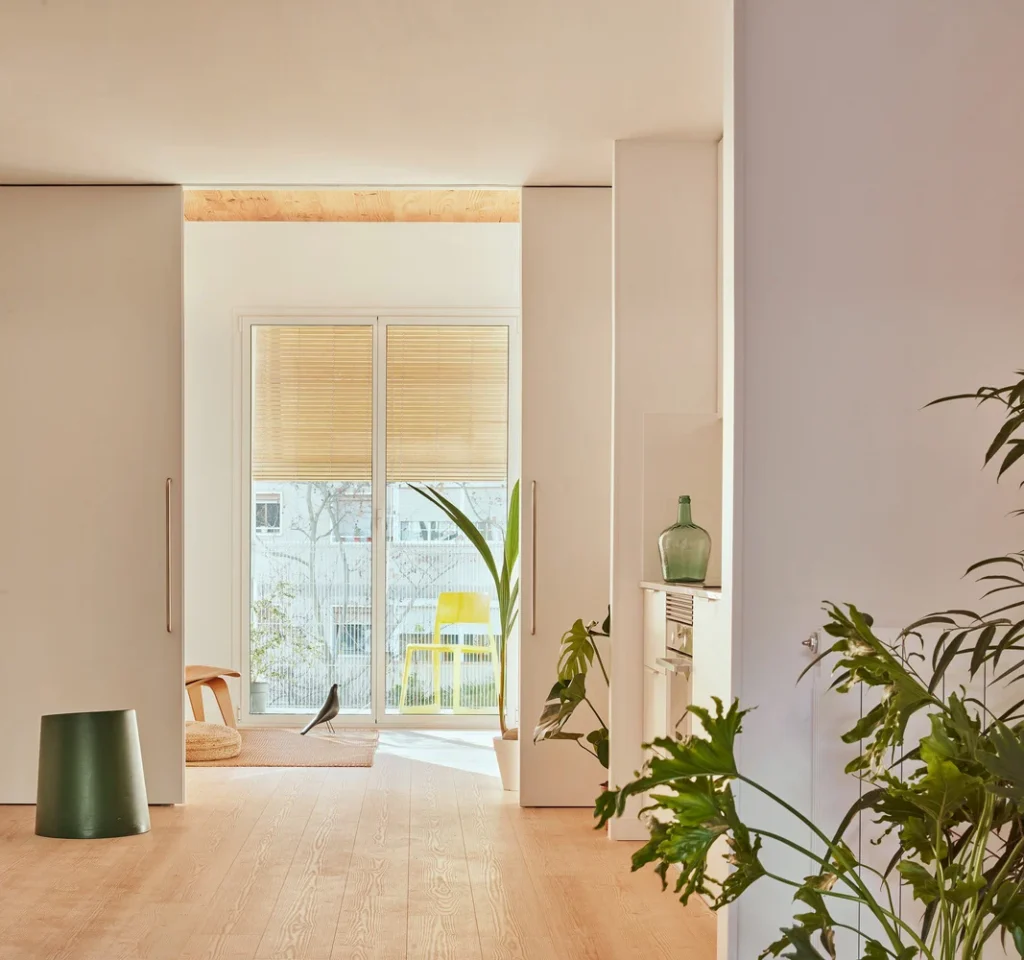
Collective housing typically responds to environmental, economic and social concerns, and this substantial complex in vibrant Barcelona is no exception. Modulus Matrix, from Peris+Toral arquitectes champions flexibility, utilitarianism and egalitarianism, wrapped in a finely honed architectural framework.
With 85 units on more than 12000m2, this 2021 social housing project delivers approximately 18 dwellings per floor with a total of 114 rooms of indeterminate nature, flexible to individual occupants’ changing needs.
These versatile units hover around a central communal plaza, which invites social interaction and a sense of community. And – with sustainability in mind – this ground-breaking complex employs cost-effective timber framing and a standardised 3.6m x 3.6m modular design format.
What we love about this project
With dual orientation, apartments look into the central courtyard as well as outwards, adding aesthetic appeal and encouraging cross-ventilation. On each level, a continuous balcony encircles both the internal courtyard, as well as tracing the building’s external façade. This loop provides a circuit for movement, encourages indoor-outdoor living and fosters neighbourly interaction.
Social cohesion is key here. Avoiding private entrance lobbies through the external perimeter, access to each dwelling is via four ‘circulation’ shafts, entered via the internal courtyard space, further ensuring residents meet and connect.
Photography: Image courtesy the architect
Social considerations also underpin the interior floor plan. Kitchens – often seen as a traditionally gendered workspace – are here, both central and visible in an effort to normalise domestic labour and avoid fixed gender roles within the home. The kitchen is positioned as a hub with rooms coming off it – avoiding the need for hallways and maximizing available living space.
Where the project shines
- Flexible multi-purpose room layout
- Modular grid format based on Japanese tatami room principles
- Economical timber-based structural system – approx 0.24 m³ of wood per built m2
- Shared communal plaza and elevated walkways
- Embracing a circular economy – potential to deconstruct and re-use materials
This multi-award-winning project is ground-breaking for its low-cost timber construction, modular design, and the amenity it offers residents. Modulus Matrix provides an interesting test case for the future of collective housing construction both in Spain and further abroad.
Find out more about Modulus Matrix
Gearing up for summer?
We’re keen for the warmer days ahead! If you’re looking for effective ways to optimise your home or development project, our experienced team can advise on the latest ventilation technologies and sustainable approaches.
Thanks for reading! Enjoy the festive season. We hope you’ll join us for Issue 9.
airwaves is an exciting industry collaboration from Universal Fans X Fanco. A membership publication for Universal Fans industry partners, this unique resource is released quarterly and showcases real-life projects demonstrating innovative approaches to air movement in residential and commercial spaces, cutting edge technology and inspirational design.
Our team are hard at work behind the scenes collating and curating the best of the best from within Australia and around the globe.
Direct to your inbox, airwaves connect your business with the information you need to stay informed and stay ahead in your industry.
Universal Fans
18 Cleeland road, Oakleigh South
Australia, 3167
You received this email because you signed up on our website or made a purchase from us.